

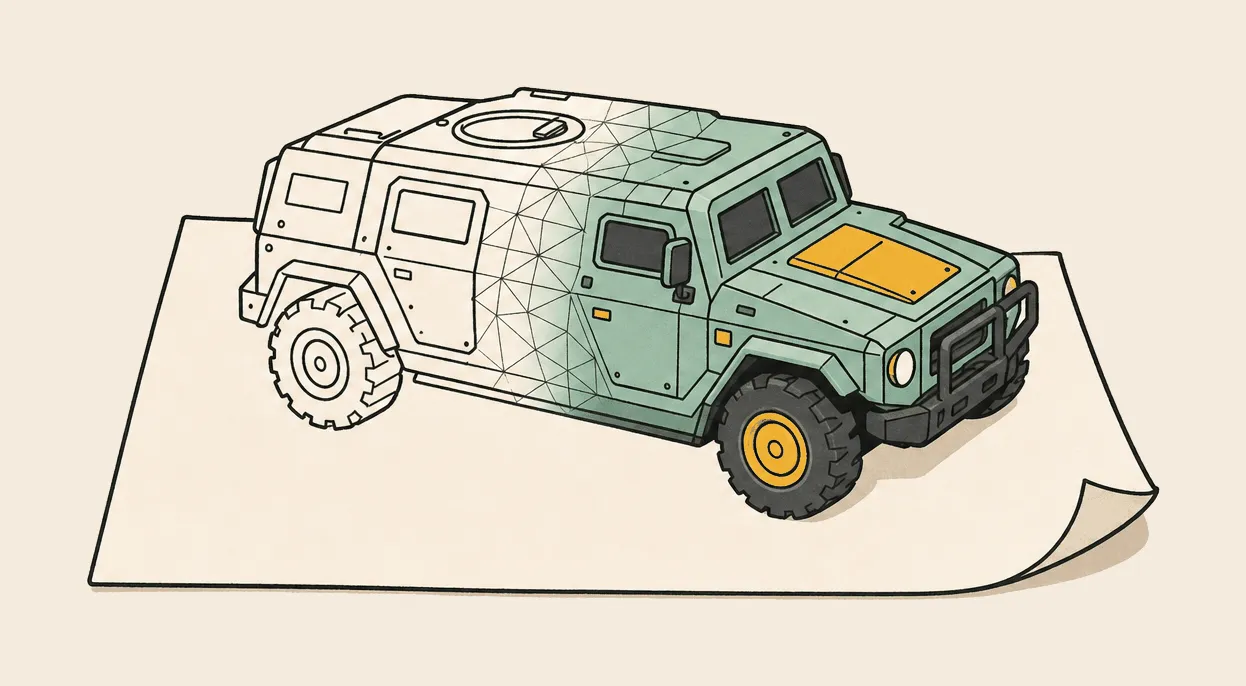
Your agent can write a game in an afternoon, and an image model will draw every car in it. But a drawing is flat. A 3D game needs models you can turn, light and knock off a tower.
That gap is where a side project stalls. A stock asset pack looks like every other game built from it, and commissioning five cars is a week and a budget line. So the prototype ships with grey boxes, and the grey boxes stay.
Our prototype had grey boxes too. Then an agent turned five drawings into five models.
Scrap Sumo
Five scrap-built combat cars on top of a tower. Last one standing wins.
Up and Down (or W and S) drive, Left and Right (or A and D) turn, Space boosts. On a phone or with a mouse, hold where you want to go and double-tap to boost.
Scrap Sumo
Five combat cars on top of a tower. Ram the others off the edge; the last one standing wins. Up and Down drive, Left and Right turn, Space boosts. On a phone, hold where you want to go.
One sheet for every car
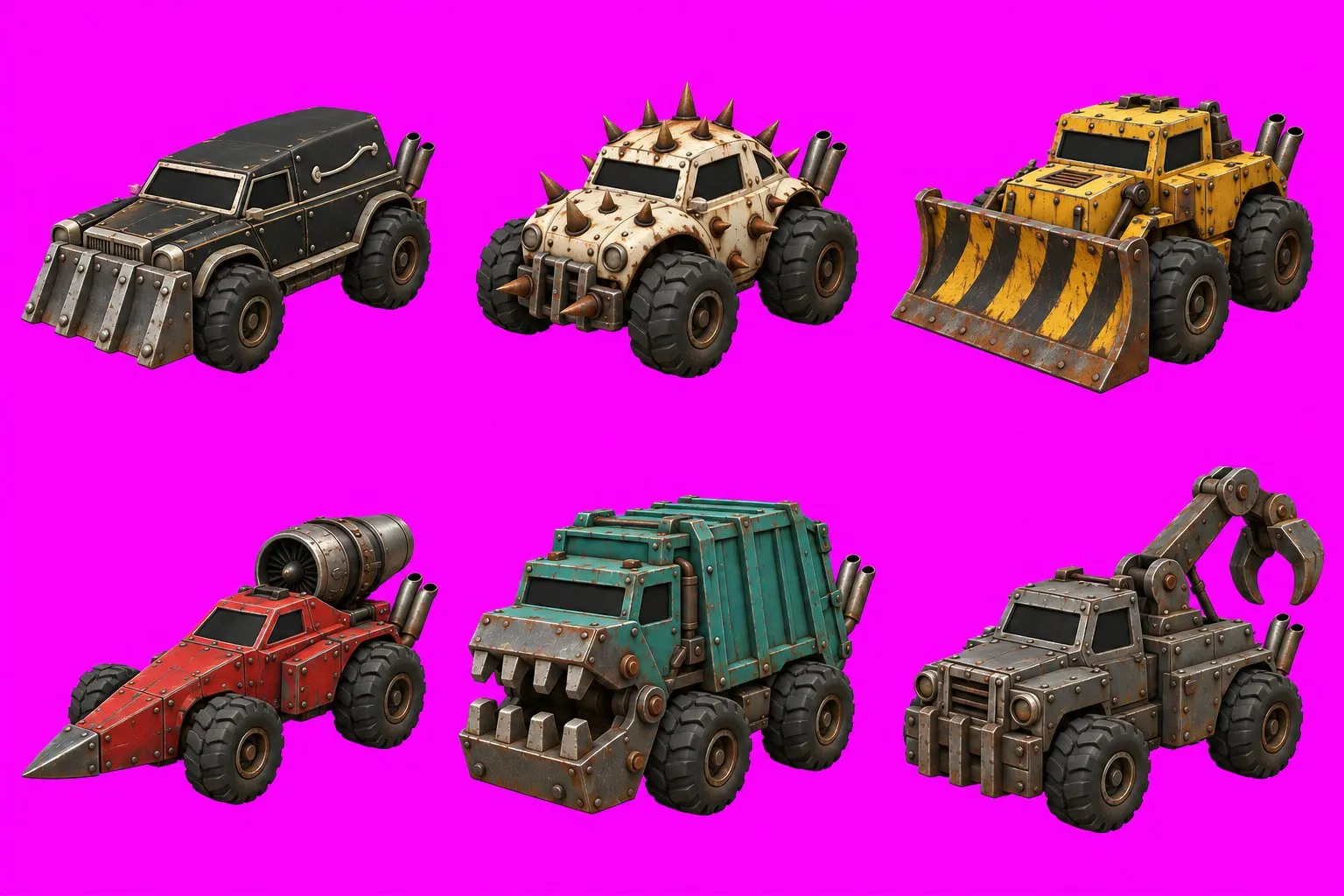
Five models generated separately come back as five unrelated objects: different angles, different scales, different ideas of what “chunky” means. So the agent asked for all of them in one image first: the five it needed, plus a spare.
 $0.04
The prompt fixed what had to match and left the rest to the model: a strict three by two grid, one flat magenta background (a colour no car uses, so it cuts out cleanly), the same camera for every car, the same tyres and armour plates on every car, and no thin parts.
That last rule matters more than it looks. Image-to-3D turns antennas, chains and wing mirrors into melted string. Everything on these cars is a slab, a spike or a wheel.
A script then cut each car out of the sheet along the magenta, which cost nothing.
Image to 3D for $0.05
Each cut-out went to Stable Point Aware 3D from Stability AI, which returns a textured GLB. The hearse took 13 seconds, and every car cost $0.046.
Two things tripped it up, and both were free to find out. It refuses images under 640 pixels, so two cut-outs had to be upscaled and sent again. And it takes the image as a URL, so each cut-out first went to a paid host for half a cent. Rejected calls are not charged.
What comes back is usable, not finished. Every model arrived tilted by the angle the concept art was drawn from, and turned about 140 degrees. A short script levelled each one and pointed its nose forward. The paint came back pale, so black needed darkening. The roof of the hearse, which the concept art never showed, is the model’s best guess.
At the size cars appear in a game, none of that shows. After a pass through glTF Transform, each model is about 400 KB, and none of it loads until you press Play.
The receipt
Everything in the game came out of one balance, $16.22 before and $15.40 after:
| What | Provider | Calls | Cost |
|---|---|---|---|
| Car concept sheets | GPT Image 2.5 (StableStudio) | 2 | $0.080 |
| 3D models | Stable Point Aware 3D (Stability AI) | 5 | $0.230 |
| Image hosting for the 3D calls | StableUpload | 7 | $0.035 |
| Arena floor and title art | GPT Image 2.5 (StableStudio) | 2 | $0.090 |
| Sound effects | ElevenLabs | 5 | $0.268 |
| Music: one track in two takes, plus a status check | Suno | 2 | $0.110 |
| Total | $0.81 |
The second concept sheet came from a sibling model, bought to compare the two. The one in the game won.
Sound and music
Silent cars felt wrong, so the same balance paid for the noise too: five sound effects from ElevenLabs at $0.0535 each, and one Suno track for $0.105, which comes back as two takes. The Snake post walks through that half of the job, so here it is only a line on the receipt.
When TaskFuel is worth it
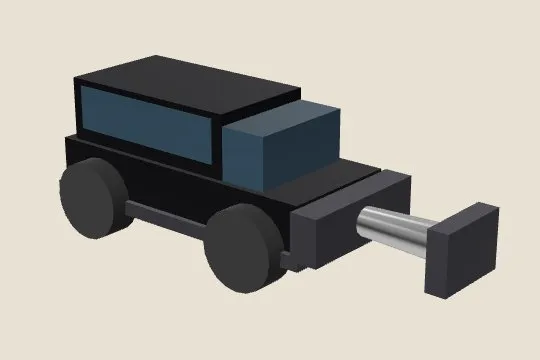
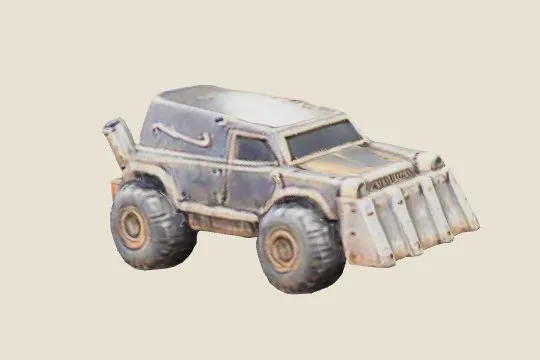
Your agent can build a car without TaskFuel, out of boxes. We gave Claude Code the hearse brief without TaskFuel: black, armoured, a battering ram on the front. It wrote one in three.js primitives. Next to it is the generated model the game uses.
 $0.046
The subscription route is a 3D generator. Meshy’s free plan gives 100 credits a month, about five models, as long as you credit Meshy under its CC BY licence, and its API starts on Pro at about $20 a month. Tripo’s free plan rules out commercial use, and its paid plan is about $20 too (checked October 7, 2026). Here each model was $0.046 and nothing needed crediting.
By hand, each car is a modelling job in Blender. The agent turned five cut-outs into five models in twelve minutes, from the first upload at 15:48 to the last model at 16:00, including two it had to upscale and send again.
What’s still rough
The models are static. Each is one fused mesh, so the wheels can’t turn and the bulldozer blade can’t lift. That’s why every weapon here is something that pushes rather than spins. A body that leans into turns and throws dust does the rest of the work.
Make your own
Pick a theme, and hand your agent this:
Using TaskFuel, make the 3D models for my game. I need five vehicles in one consistent style. First generate a single concept sheet with all five in a grid on a flat magenta background, same camera angle and scale, no thin parts, and show it to me before spending anything on 3D. Once I approve it, cut each vehicle out, turn each one into a textured GLB, and tell me what every call cost.
Connect your agent and the first $1 is on us.